
the story behind poster design
Some posters begin with a simple, playful idea. Perhaps it is a funny thought, an unexpected combination of words, a striking colour, or simply an image that looks good on a wall. These posters can be decorative, entertaining and visually appealing. They do not necessarily need to carry a deeper meaning. Sometimes, a poster simply needs to make you smile. But not every poster starts that way. Some posters come from the heart.
They can grow out of frustration, curiosity, hope, anger or a feeling that is difficult to put into words. Sometimes a poster is created because you look at the world and wonder why things are the way they are. Sometimes it comes from a personal experience. And sometimes there is simply an emotion that refuses to go away until it has found a visual form.
That is one of the things I find fascinating about poster design. A poster can be decoration, but it can also be a statement. It can be funny and serious at the same time. It can look simple while carrying a surprisingly complicated thought.
creativity from the heart
For everyone, your background plays an important role in shaping who you become. Of course, your upbringing does not determine everything. People are unpredictable, and we all make our own choices. But the environment in which you grow up can leave a lasting impression. The things you see, hear and experience as a child often become part of the way you look at the world.
Imagine growing up in a family of musicians. There is a good chance that music will be present throughout your childhood. You hear instruments being played. You hear conversations about music. You see rehearsals, performances and the work that goes into creating something. Even if you never become a musician yourself, you may develop an instinct for rhythm, sound or performance.
A good example is Formula 1 driver Max Verstappen. He grew up surrounded by motor racing. His father, Jos Verstappen, was a Formula 1 driver, while his mother, Sophie Kumpen, was a successful racing driver. Racing was therefore not something Max discovered later in life. It was part of his environment from an early age. He is racing from the heart.
That does not automatically make someone a great racing driver. Talent, discipline, personality, opportunity and an enormous amount of hard work are also involved. But your surroundings can certainly influence what feels natural to you.
growing up around graphic design
In my own case, creativity was also part of my surroundings. I grew up amongst graphic designers, decorators and painters. Visual communication was therefore not something completely foreign to me. I was surrounded by people who understood how things could be made, arranged and presented. Naturally, you pick things up.
You learn by watching. You learn by looking. You learn by seeing what works and, perhaps even more importantly, by seeing what does not work. That does not mean that growing up around graphic designers automatically makes you a brilliant graphic designer. It does not. Knowing how something is made and being able to make it well are two different things. But it can develop something else: an instinct. And instinct is extremely important in creative work.
Sometimes you cannot immediately explain why something feels right. You simply know that it is. A particular colour works. A word sits perfectly in a certain position. An image needs more space. A design needs to be louder, quieter, stranger or simpler. This instinct is a significant part of how I approach poster design. You know it from the heart.
the idea comes first
For me, the concept behind a poster is particularly important. A beautiful poster is nice to look at. A funny poster can make you laugh. A colourful poster can brighten a room. But when a visual idea also communicates something, the poster can become much more interesting. That something does not have to be complicated. In fact, sometimes the simplest message is the most powerful and just from the heart. A few words can make you think. A strange combination of text and imagery can make you stop. A seemingly ridiculous statement can suddenly become surprisingly meaningful. This is where emotion enters the creative process.
Some of the posters in the typo chaotic collection are deliberately playful. Others are more thoughtful. Some are intended to make you laugh, while others might make you slightly uncomfortable. There are posters about hope, authenticity, humanity, courage, everyday life and the absurdity of the world around us. The decorative effect is still important. After all, a poster is something you put on a wall. It becomes part of your home, office, studio or other personal space. But decoration is not necessarily the whole story.
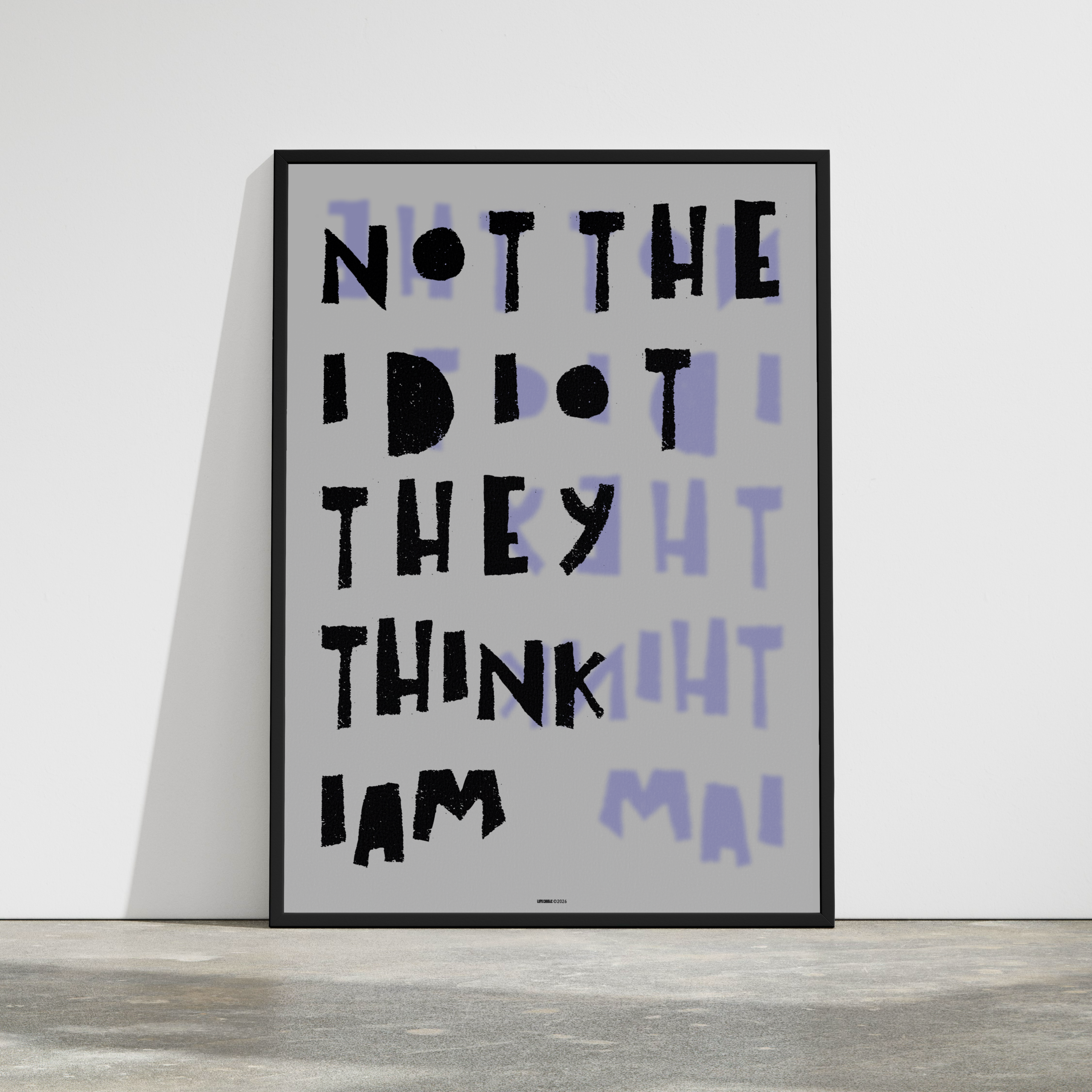
not the idiot they think I am
One poster that illustrates this particularly well is not the idiot they think I am. At first glance, the sentence is funny. It has an element of sarcasm and perhaps even a little defiance. You can imagine someone looking at it and immediately smiling. But there is something underneath the humour. How often do we make assumptions about other people? And how often do other people make assumptions about us?
Being judged is something almost everyone experiences. Someone may decide that you are stupid, difficult, strange, unsuccessful, arrogant or simply different. They may reach that conclusion without knowing your story, your circumstances or the reasons behind your choices. That is where the poster becomes more than a funny piece of wall art. The words invite you to question the difference between how someone appears and who they actually are.
You can grow up surrounded by knowledge about how to create something. You can learn techniques, design principles, composition, typography and visual communication. You can develop an understanding of colour and form. But none of those things automatically teach you about the human being behind the work. So from the heart.
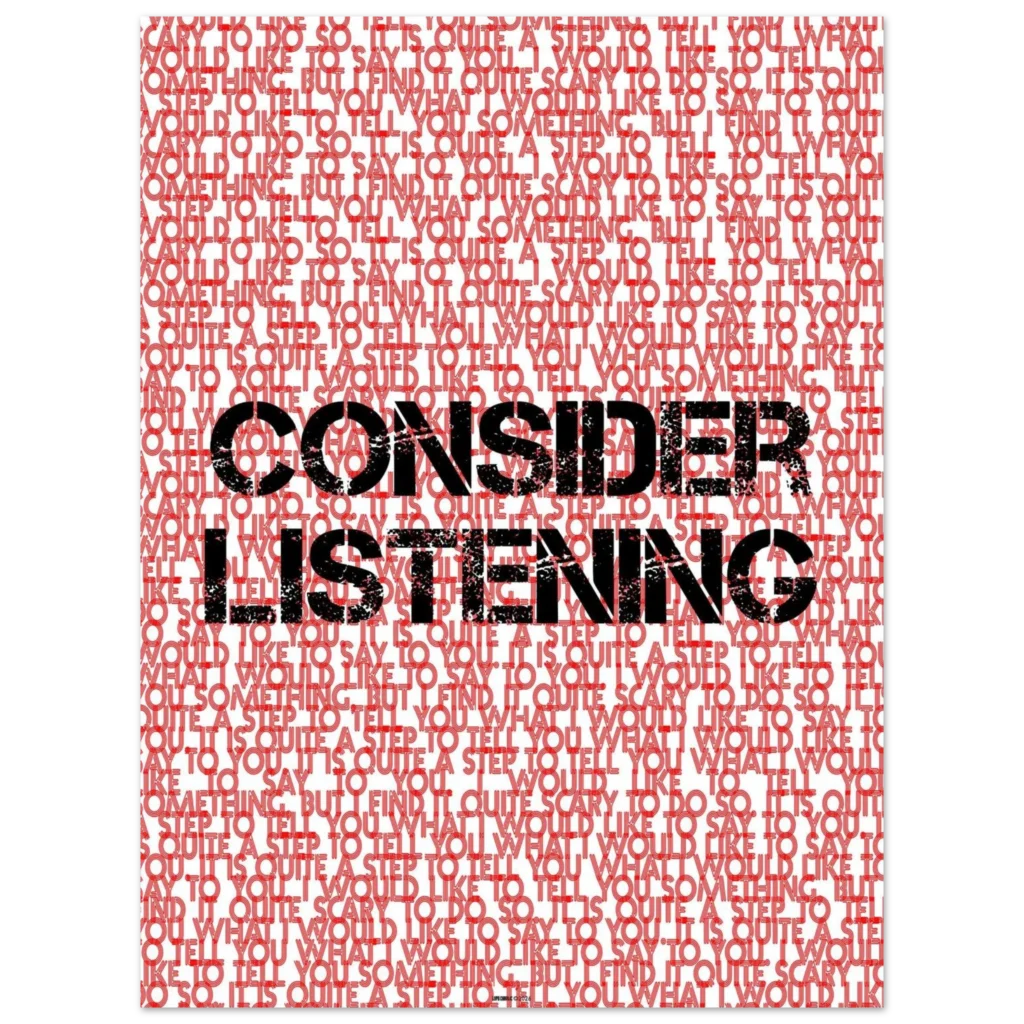
creativity is also about humanity
This is perhaps the most important point. Design is not only about making something look good. Art and graphic design are also ways of responding to the world. Sometimes that response is joyful. Sometimes it is angry. Sometimes it is confused. Sometimes it is hopeful. Sometimes it is simply absurd. A poster can capture one of those feelings and put it on a wall.
That is why I believe the story behind a poster matters. Not every design needs a detailed explanation. It can come just from the heart. Sometimes the viewer should be allowed to decide what it means. A good poster can create a conversation between the person who made it and the person looking at it. Perhaps you recognise yourself in the words. Perhaps you disagree with them. Perhaps they make you laugh. Or perhaps they make you think about something you had forgotten. That is the beauty of creative work.
more than decoration
A poster can certainly make a room look better. It can add colour, personality and character to an otherwise empty wall. But the best art posters can do more than decorate. They can communicate. They can challenge. They can comfort. They can provoke. They can make you laugh.
And sometimes, they can simply remind you that someone else has experienced the same strange, funny or frustrating things that you have. That is what I hope to achieve with typo chaotic.
Some posters begin with a fun idea. Others begin with an emotion. Some are created because something looks good. Others exist because something needed to be said. And perhaps that is the most interesting thing about poster design: you never really know where an idea will come from. It might come from a sketch, a conversation, an observation or a frustrating day. Or it might simply come from the heart.